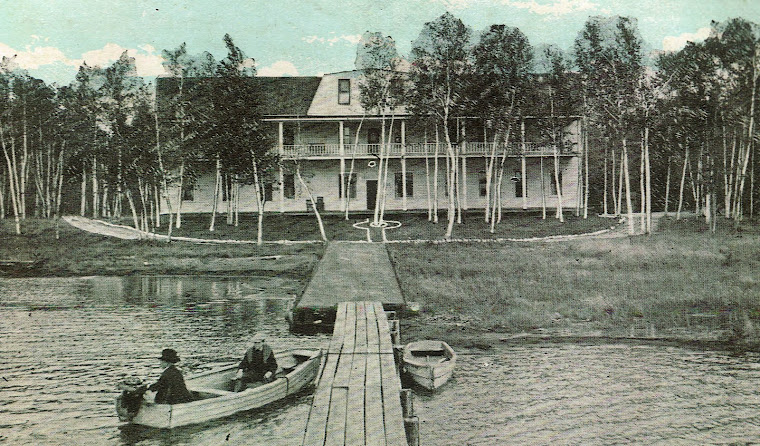
Historic Birch Lodge

Historic Birch Lodge
Historic Birch Lodge, Trout Lake, MI
Showing posts with label Historic Site. Show all posts

Saturday, March 23, 2013

Point Iroquois Lighthouse, Bay Mills, MI

Print Friendly and PDF
Point Iroquois LIghtstation, Bay Mills, MI

The Point Iroquois Lighthouse is located just west of Bay Mills, at Iroquois Point on Lake Superior.
This is about 40 minutes from Birch Lodge and Trout Lake, MI  The point itself, got its name from a battle between the Iroquois who had invaded the area in search of control of trade and fur trapping.  They were vanquished here at this place by the local Ojibwa.  This significant battle stopped the western progression of the Iroquois.  It was documented that in the 1700's a fur trader could still see human bones on the beach.
Beach at Point Iroquois Lighthouse, Bay Mills, MI
Beach at Point Iroquois

The first lighthouse on this site was built in 1855, two years after the Soo Locks were begun.  It was built to guide ships from Lake Superior into the St. Mary's River.


The original structure was built of wood and rubble, and stood 45 feet tall.  It was equipped with a Fresnel Lens.


 By 1867 the quality of the structure was questioned, and a new lighthouse and keepers home were planned.
Point Iroquois Lighthouse, Bay Mills, MI

The current lighthouse dates from 1870.  It is a white cape cod style structure, and has a 665 foot tall tower.  It operated until 1962 when it's function was replaced by the Canadian operated light at the mouth of the St. Mary's River.  In 1975 this light was placed on the National Register of historic Places.  It is currently part of the Hiawatha National Forest

.Daily tours are offered at the Point Iroquois Lighthouse, and you may climb the tower to view Lake Superior. Summer hours are from 10am to 5pm daily. 

Lake Superior at Point Iroquois LIght, Bay Mills, MICurrently they are searching for a volunteer caretaker to live at and care for the lighthouse.  They ask a minimum commitment of one year.  Are you interested?  Here is a link to click:
Point Iroquois Lighthouse Facebook 
Hasn't everyone always  secretly wanted to live at a lighthouse on Lake Superior??

Sunday, March 17, 2013

Old Indian Burial Ground, Bay Mills, MI

Print Friendly and PDF
Old Indian Burial Ground, Bay Mills, MI
While staying at Birch Lodge, you may wish to take a drive along the Whitefish Bay Scenic Byway... it runs along the south shore of Whitefish Bay, from Brimley to M-123 south of Paradise, MI.

Old Indian Burial Ground, Bay Mills, MI
One of the interesting sites along the shore of Lake Superior at Bay Mill, MI (besides the casino) is a scenic old Native American cemetery.  Although the cemetery is located along the busy roadway, you can not help but feel the serenity of pines, hear the sound of the waves, and feel the peace of this place.

The cemetery is fenced, and no access is allowed.   However, from outside the fence it is possible to see the wooden spirit houses over the graves.


Spirit Houses, Old Indian Burial Ground, Bay Mills, MI
During earlier times, spirit houses were built of birch or elm bark and placed over the graves; later graves were protected by spirit houses built of lumber.

 Besides protecting the grave, they held tools and resources that the dead would need to sustain them on their trip to the land of the spirits.


White Pine and Sign in memorial of Chief John Waishkey

Also at the cemetery, at the base of a large white pine tree, is a sign that reads:

 "Among the Indians who moved from Nay Oh Me Kong to what is not the Indian mission at Bay Mills was a little girl of fifteen named Eliza Waishkey nee Eliza Labranch.  It was Eliza who selected the tree, then only a twig, and planted it at the head of her father's grave who was Chief John Waishkey of the Waishkey band of Chippewa Indians.  The tree, a white pine, was planted about the year 1841."

Some searching found little information on Chief John Waishkey, however, his loving daughter, Eliza married Xazvier Labranch and passed at age 70.  They are buried at the Bayview Cemetery.

  I hope you will take time to visit this small and serene spot, and think of this place as it was in 1841, when Eliza planted that tree.

Sunday, March 10, 2013

Eckerman, MI Trout Pond

Print Friendly and PDF
Eckerman, MI Trout Pond
Eckerman, MI Trout Pond Site
Eckerman, Mi Trout Pond
Bill and I were looking at topographic maps of the area, and noticed the Eckerman Trout Pond east of M-123 just north of M-28.  This is less than a dozen miles north of Birch Lodge, so we took a little trip.  The access trail leads down away from the road just south of where the Tahquamenon River crosses M-123.

This was once the site of a trout rearing pond, and now is an access point to the river and a great place for a picnic.


  A scenic old structure lies in ruin at the edge of the forest, and the sluice ways controlling the water flow are still apparent along paths across the bridge from the parking area.


Although I was not able to find the history of this particular facility, I did find out about the general history of the fish hatcheries program from the history page of the DNR.


As a result of logging, river damming, and the lack of quotas, the state's fisheries were largely devastated by the end of the 19th century, and there was a need to restock streams, rivers and lakes.

Old Sluice Gates
The first restocking attempt to rebuild fisheries led to the introduction of several foreign species that were popular with the recent European immigrants.   Carp, brown trout, and rainbow trout were introduced, and species like whitefish, herring and large and small mouth bass were spread to waters they did not inhabit previously.  Fish were released as fry, which had limited survival.

The next phase of stocking focused on sport fishing, and trout were of prime interest.  Again, several species of trout were introduced that were not native to Michigan.  With increased technology, fish were now released as fingerlings, but again, very few survived to reproduce in the wild.

Later, it was decided to grow the trout in ponds until they were of legal size to catch, and then release them.  No improvements had yet been made to habitat.  Avid fishermen would actually follow the release trucks to catch the newly released and easily caught trout.  Even though these trout were mature, they were not raised in the wild, and had a very limited success in reproducing.

Trout Photo From DNR Fisheries Poster
Finally, the DNR recognized that by providing the fish with the proper habitat, fish could reproduce naturally.  It was at this point that many of the trout rearing ponds were discontinued.  Hatcheries returned to raising fingerlings, and releasing them in suitable habitats to grow and reproduce in the wild.

I believe it was probably at this point that Eckerman Trout Pond was sidelined.

 Today it is a very pretty picnic site, as well as a good spot to fish on a stocked and established trout stream...perhaps a victim of the program's own success.

Thursday, February 7, 2013

Penny Pine Project

Print Friendly and PDF


Driving west along M-28 toward Engadine, we noticed a bronze plaque on a boulder on the south side of the road.  We stopped to read it "Michigan D.A.R. Forest August 1931".


 I took some pictures, and wondered about a bunch of silver haired D.A.R. ladies planting pines in 1931.  What was this about?  Eventually, I did a google searches and learned something.


The U.S. Forest Service, with the help of the C.C.C. began a program to reforest America.  In addition to putting millions of people to work, the program sought to replenish the country's forests devastated from over harvesting and wildfire. 

The trees were grown in U.S. Forest Service nurseries.  In addition to supplying the C.C.C., these seedlings were also sold to individuals, and donations were sought to help sponsor the cost of the program.  The cost of the seedlings was one penny, hence the name Penny Pine.

Margaret March-Mount
Forest Service Photo
A Forest Service employee, Margaret March-Mount, working from the Munising district, came up with the idea of promoting replanting and forest fire prevention through the development of a Children's Conservation Crusade, encouraging children to donate pennies for the replanting effort.
She was also instrumental in organizing sponsorship programs through various clubs and organizations. ( For more information on Ms. March-Mount please read  the Forest Service History Page.)


In celebration of the Golden Jubilee of the D.A.R., Mrs Henry Robert, President of the National D.A.R. chose to participate in the Penny Pines Project.  Her goal was to establish a D.A.R. memorial forest planting in every state.  Each planting was to be a minimum of one acre planted to 500 pines at a cost of $5.00.  The C.C.C. did the actual planting and maintenance.

The large boulder along M-28 marks the D.A.R.s contribution to the replanting of 160 acres in Michigan in 1931.  A sizable planting at the time. 

The Penny Pines Program continues today, although I have not found active Michigan plantings.
Donations are sought by members of the National Garden Club and the U.S. Forest Service.  The cost of sponsorship is the minimum now required to plant one acre, currently $68.00  For more information, here is the link:  http://www.gardenclub.org/projects/ongoing-projects/penny-pines.aspx

Monday, October 29, 2012

The Centennial Cranberry Farm

Print Friendly and PDF
Centennial Cranberry Farm, Paradise, MI
Thinking about craisins for my oatmeal got me thinking about the Centennial Cranberry Farm up on Whitefish Point.  Whitefish Point is only about 45 minutes north of Birch Lodge on M 123, so we followed the sign pointing off M 123 and went for a visit.
Lake Superior Dune, Whitefish Point MI

The farm is located on a natural cranberry bog adjacent the dunes along Lake Superior's south shore.  It truly feels in a world of its own, with only wild lands bordering it to the west, it seems an outpost.

Cranberries, Whitefish Point, MI

Currently there are thirteen acres of improved fields planted with cultivated strains of cranberries.

Centennial Cranberry Farm was founded in 1876 by John Clarke, the great-uncle of the current owner Loren House.  He had visited the area while working as a fisherman in  1873, and felt that the berries here could be cultivated and turned into a business. 

We met Loren in the gift shop, and were disappointed to learn that the hot dry summer had devastated the crop.  So few berries were produced that they had not been harvested.  He graciously let us wander through the cranberry fields, and told us about the video, equipment and old photos on display for visitors.

For harvest, the fields are usually flooded by pumping water from a small lake bordering the fields, which allows the berries to float to the top of the water as the mechanical harvester threshes the berries off of the vines.

  A boom is then deployed on the water to collect the raft of berries, which are then scooped up a conveyor onto a truck.  The berries are then shipped to Wisconsin for further processing.


Loren said he is thinking of retiring, and is hoping the grandsons will continue to farm the bog, but he is a little uncertain they will continue the business.  I hope they will---this is really a fascinating place to see.   It made our visit with him kind of like the cranberries--a little bittersweet.

Vintage photos and harvest photos curtesy of the Centennial Cranberry Farm....oh and Bill thinks he might make a cranberry farmer.....