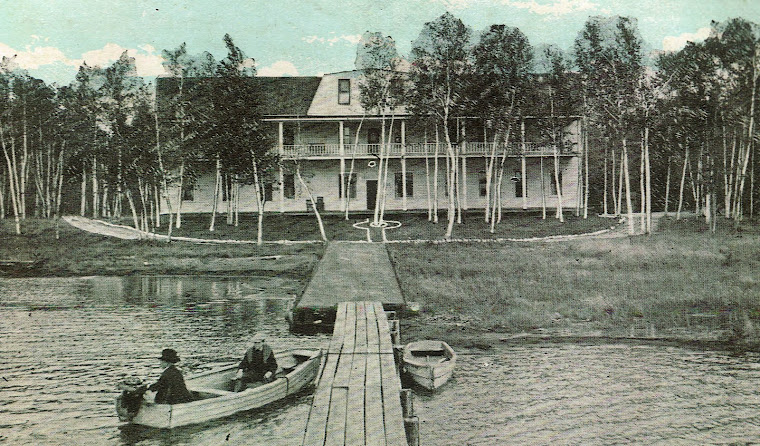
Historic Birch Lodge

Historic Birch Lodge
Historic Birch Lodge, Trout Lake, MI
Showing posts with label Fishing. Show all posts

Monday, March 18, 2013

Trout Fishing in the Eastern Upper Peninsula

Print Friendly and PDF While searching information for my blogs, I came across several links that may be of interest to those wishing to go trout fishing in the Upper Peninsula of Michigan.   Trout Lake, (aka Carp Lake) where Birch Lodge is located, is rumored to have some lake trout, but in reality, many of the area lakes and streams contain several species of trout and are open to fishing.

Here is a map for our area I found from the Michigan DNR, other areas are also available on that link.  Streams and lakes highlighted are for trout, click on the DNR link above for more information.
All of these areas are less than an hour's drive from Birch Lodge, most are about 30 minutes.

 
In addition, beginning April 1, 2013, the Michigan DNR is employing an experimental increase in the daily limit of brook trout in several streams in Michigan.   This would double the daily limit from 5 to 10 in 2013.   One of these streams is the Eastern Branch of the Tahquamenon River.  Basically, this  experimental area pertains to the waters upstream from the bridge on M 123 north of Eckerman MI.
Eckerman, MI is 11 miles north of Birch Lodge, Trout Lake, MI on M 123.


Although we won't be open to put you up in April, I hope this will give you something use for planing your trip to the U.P.  In the meantime, you can dream about all those fish! 


Sunday, March 10, 2013

Eckerman, MI Trout Pond

Print Friendly and PDF
Eckerman, MI Trout Pond
Eckerman, MI Trout Pond Site
Eckerman, Mi Trout Pond
Bill and I were looking at topographic maps of the area, and noticed the Eckerman Trout Pond east of M-123 just north of M-28.  This is less than a dozen miles north of Birch Lodge, so we took a little trip.  The access trail leads down away from the road just south of where the Tahquamenon River crosses M-123.

This was once the site of a trout rearing pond, and now is an access point to the river and a great place for a picnic.


  A scenic old structure lies in ruin at the edge of the forest, and the sluice ways controlling the water flow are still apparent along paths across the bridge from the parking area.


Although I was not able to find the history of this particular facility, I did find out about the general history of the fish hatcheries program from the history page of the DNR.


As a result of logging, river damming, and the lack of quotas, the state's fisheries were largely devastated by the end of the 19th century, and there was a need to restock streams, rivers and lakes.

Old Sluice Gates
The first restocking attempt to rebuild fisheries led to the introduction of several foreign species that were popular with the recent European immigrants.   Carp, brown trout, and rainbow trout were introduced, and species like whitefish, herring and large and small mouth bass were spread to waters they did not inhabit previously.  Fish were released as fry, which had limited survival.

The next phase of stocking focused on sport fishing, and trout were of prime interest.  Again, several species of trout were introduced that were not native to Michigan.  With increased technology, fish were now released as fingerlings, but again, very few survived to reproduce in the wild.

Later, it was decided to grow the trout in ponds until they were of legal size to catch, and then release them.  No improvements had yet been made to habitat.  Avid fishermen would actually follow the release trucks to catch the newly released and easily caught trout.  Even though these trout were mature, they were not raised in the wild, and had a very limited success in reproducing.

Trout Photo From DNR Fisheries Poster
Finally, the DNR recognized that by providing the fish with the proper habitat, fish could reproduce naturally.  It was at this point that many of the trout rearing ponds were discontinued.  Hatcheries returned to raising fingerlings, and releasing them in suitable habitats to grow and reproduce in the wild.

I believe it was probably at this point that Eckerman Trout Pond was sidelined.

 Today it is a very pretty picnic site, as well as a good spot to fish on a stocked and established trout stream...perhaps a victim of the program's own success.
Monday, October 8, 2012

Trout Lake, MI Salmon Run!

Print Friendly and PDF
Salmon, Carp River, St. Ignace, MI
A couple recently staying with us had grown up in the area, and knew it well.  They were regaling us with stories including fishing for salmon during the salmon run each fall, and they said salmon might be seen right about now.

We had heard tales that Big Trout Lake (aka Carp Lake) will occasionally yield a salmon or two, but we found this hard to believe.  Our electrician also said he remembers pulling salmon and pike out of the area ditches as a boy.  So when things got a little slower, we went salmon hunting--with a camera.

Carp River, Trout Lake, MIThe Carp river flows out of the south end of Big Trout Lake.  A quick look below the on Huckleberry Rd.  certainly yielded no fish.   Nor did the bridge over the Carp at M 123.   So we decided if necessary to go on downstream all the way to it's mouth on Lake Huron,  northeast of St. Ignace.


Carp  River, Trout Lake, MI
The next stop for us downstream was at the access off of East Lake Rd.

  I didn't really expect to see much, but Bill said "Look, THERE!".  Yup.  There was a lonely salmon, biding it's time in a pool in the river.

Salmon,  Carp River, Trout Lake, MI
    I thought there will be more downstream, even though we were probably past the main run.   So off we went.

We stopped at the bridge over the Carp River on the Mackinac Trail, north of St. Ignace.  Walking downstream, Bill spotted some more swimming against the current upstream.
Salmon Run, Carp River, St. Ignace, MI


  The further downstream we walked, the more there were.

  At one point a shallow area of gravel and stone formed almost a rapids that they fought to get up.  Very amazing to watch.


That these were late comers was evident by the number of tracks and dead fish on the waters edge.

We decided to check out the mouth of the river, but found it was too deep to see any fish.


 But I always enjoy looking out on the big lakes, and it seemed a fitting end to our quest... next year this is where it will all begin....again.